–how can I guess why Ai must not weep? […]
Yet his name is a cry of pain. For that I first sought him out in Erhenrang, a long time ago it seems now; hearing talk of “an Alien”, I asked his name, and heard for answer a cry of pain from a human throat across the night.’
The Left Hand of Darkness, Le Guin, Ursula (2017[1969])
[Emphasis added]

In 1993, I was in a production of Euripides’ The Women of Troy, the first project in my third and final year of drama school. It was most likely translated in 1990 by Don Taylor (2007). I cannot recall exactly, but I do remember the letters ‘Aieeee’, a wail or a cry of utter despair. And it is in Taylor’s text that I have found that sound spelt out. (What I do recall is that the production was extremely physical, and in retrospect, relied on a form of expressionism rather than realism; although it was, for me, the most real I have ever felt during a performance.)
Throughout rehearsals, I was puzzled by one of my friends’ decisions, wondering why she kept reading, then performing the sound Aieeeee so literally. She played Hecuba (or Hecabe, depending on translation), the Queen of Troy during the Trojan War. After learning that lots have been drawn by the men who have enslaved them, the women prisoners are told they will be sent away from their homes to live with appointed masters. In this production, Hecuba sat on the floor crying about the random categorisation that she faces, learning a few lines later that her daughter Cassandra will be sent somewhere different to her.
‘Aieeeee . . .! Where then? Phthia? Somewhere else in Thessaly? Or is it to be Thebes, Cadmus’ city?’
(Euripides, 2007: 14).
In Greek, these lines look like this:
αἰαῖ, τίν᾽ ἢ Θεσσαλίας πόλιν
ἢ Φθιάδος εἶπας ἢ Καδμείας χθονός;
(Euripides, Troades 241–42)
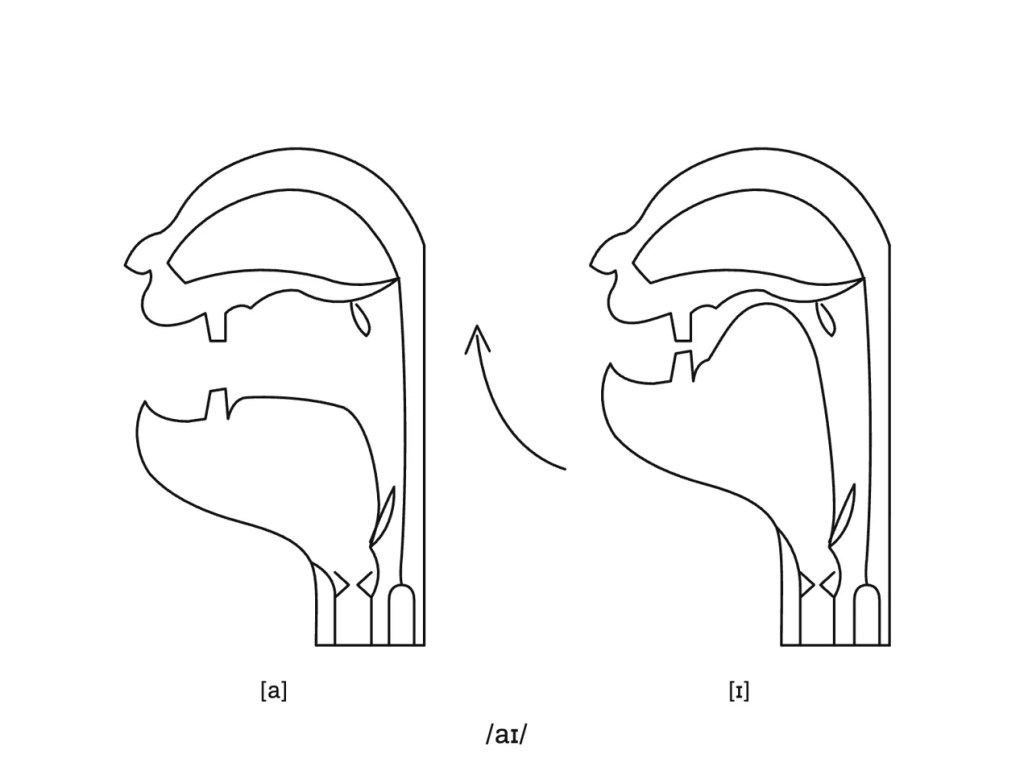
I am struck by the relationship between the letters chosen collectively — or reluctantly given into — to represent a technology spoken about daily in the news, with increasing levels of panic, and the emotional sound they have long indicated; a cry, a lament, an expression of tragedy. — [a] is the open vowel, jaw dropped, tongue flat, nothing in the way of the breath — and then [ɪ] is the jaw and tongue closing, almost. Repeated, it becomes the heave and letting go of voiced breath, a wail. Since I am prone to conflation, I remind myself and anyone reading this to retain the difference: the Greek letters αἰ represent one sound, /aɪ/, the vowel in eye. It glides, a diphthong, as the diagram above shows, but is a single movement. Spoken aloud, however, A and I – together, the commonly accepted umbrella term to describe dynamic digital pattern-recognition processes, often with natural language processing skills – are two letter-names, /eɪ/ then /aɪ/ — vocal shapes that in English sound like may, and eye. The resemblance between αἰ and AI is what I see, not what I hear. Perhaps what I am beginning to hear is an ancient cry clipped, abbreviated.
αἰ is often repeated, becoming αἰαῖ· Depending on the time, culture and language, the sound αἰαῖ (/aɪ.aɪ/, roughly eye-eye) is rendered in a variety of ways. Even in Greek today, the sound is different to how it was, and a Greek person would sound out eh-eh rather than eye-eye.
Translation varies too. On the Perseus Digital Library, E.P., Coleridge’s English translation produces αἰαῖ as ‘Ah me! What city did you say, Thessalian, Phthian, or Cadmean?’
(Euripides, 1891, 241–42).
Or on the Gutenberg.org library, the line is slightly different still: ‘What lord, what land. . . Ah me, Phthia or Thebes, or sea-worn Thessaly?’ This translation, by Murray, moves the cry to the centre of the question.
(Euripides, 1905, p. 23).
But for us drama students in 1993, the most recent of all translations listed here, the sound was rendered Aieeee. My friend, remaining faithful to the letter – genuinely – followed in a long tradition of ritualised lament. For centuries, the form was αἰαῖ, perhaps most closely rendered in English texts today as Aieeee.
Although a cry of pain is very often written αἰαῖ in ancient Greek text, it isn’t the only symbolic lament — ἰώ, οἴμοι, φεῦ and others all appear — but αἰ recurs so often it eventually enters into narrative. Sophocles exploits this frequency when he writes about Ajax, a warrior who fought in the Trojan War, and has him cry ‘αἰαῖ’ before observing that his own name, Αἴας, is close enough to be almost onomatopoeic.
Aiai! Who would ever have thought that my name would so descriptively suit my troubles? For well now may Ajax cry “Aiai”—yes, twice and three times. Such are the harsh troubles with which I have met.
(Sophocles, Ajax 430–33, Storr’s text; trans. Jebb)
In Greek it looks like this:
αἰαῖ· τίς ἄν ποτ᾽ ᾤεθ᾽ ὧδ᾽ ἐπώνυμον
τοὐμὸν ξυνοίσειν ὄνομα τοῖς ἐμοῖς κακοῖς;
νῦν γὰρ πάρεστι καὶ δὶς αἰάζειν ἐμοὶ
καὶ τρίς·(Sophocles, Ajax 430–33)
In Latin, the sound becomes simply AI as shown below in the Roman poet Ovid’s fragment. Ovid plays with this similarity further when he suggests (across books Ten and Thirteen of Metamorphoses) that the flower which grew from Ajax’s blood on the ground contains the letters of his name which resemble the sound of pain ‘αἰαῖ’. The flower carries the mark AI, which human readers see as co-joined letters, a single sign that means two things – for Hyacinthus a lament, for Ajax a name.
(The English rendering Ajax — /ˈeɪdʒæks/ — arrives with us from the Latin Aiax. i and j become interchangeable in Latin by the time our ancestors invented printing and in the 17th century, split them. In English at least, we routinely read J as the harder /dʒ/. But there was no J in Latin. Spoken originally, it was Aiax – roughly “Ai-yax” – meaning the name began with an open-mouthed sound reminiscent of a cry.)
The mark AI appears in Metamorphoses, Book Ten, as Ovid sets the connection up when Hyacinthus is killed and Apollo laments his death (Note that More, the English-speaking translator (1922), chooses his own line breaks) :
But Phoebus was not satisfied with this.
For it was he who worked the miracle
of his sad words inscribed on flower leaves.
These letters AI, AI, are inscribed
on them(Ovid, Metamorphoses 10.214–16)
In Latin:
non satis hoc Phoebo est (is enim fuit auctor honoris):
ipse suos gemitus foliis inscribit, et AI AI
flos habet inscriptum, funestaque littera ducta est.
(Ovid, Metamorphoses, 10.214–16)
And then later in Book Thirteen, as Ajax kills himself, the motif, we are told by Ovid, is repeated and means two different things, the name and ‘a cry of woe’:
This is at least
my own; or will Ulysses also claim
this, for himself. I must use this against
myself—the blade which often has been wet,
dripping with blood of Phrygians I have slain.
Will drip with his own master’s blood,
lest any man but Ajax vanquish Ajax.”
Saying this, he turned toward the vital spot
in his own breast, which never had felt a wound,
the fated sword and plunged it deeply in.
though many sought to aid, no hand had strength
to draw that steel—deep driven. The blood itself
unaided drove it out. The ensanguined earth
sprouted from her green turf that purple flower
which grew of old from Hyacinthine blood.
Its petals now are charged with double freight—
the warrior’s name, Apollo’s cry of woe.
([emphasis added], Ovid, Metamorphoses, 1922, 13.387–98).
nec valuere manus infixum educere telum:
expulit ipse cruor, rubefactaque sanguine tellus
purpureum viridi genuit de caespite florem,
qui prius Oebalio fuerat de vulnere natus;
littera communis mediis pueroque viroque
inscripta est foliis, haec nominis, illa querellae.
(Ovid, Metamorphoses, 13.393–98)
I cannot find a flower that has the marks AI on them (and yes, I could, of course make them with AI!) Hyacinths as we know them today are not these, but that is another post entirely.
Nevertheless, roughly 2000 years later, in 1969, Ursula Le Guin, who, like Euripides, Sophocles and Ovid, was also not speaking of 21st-century technology, but something deeper and perhaps more intrinsic to the human condition, chose the letters AI when she wrote about Mr Genly Ai. And she was also not writing about narrow references to technology alone when she wrote, ‘I don’t know what the devil you are, Mr. Ai, a sexual freak or an artificial monster or a visitor from the Domains of the Void, but you’re not a traitor, you’ve merely been the tool of one. I don’t punish tools. They do harm only in the hands of a bad workman’ (2017: 25).
I do not know what Le Guin would say today, in hindsight, about the notable or coincidental visual resemblance between her protagonist’s name in The Left Hand of Darkness, the wail of pain in Greek and Latin mythology, and the term now used for contemporary so-called intelligent technologies, Artificial Intelligence, or AI as it is most commonly referred to. At present, technologies such as large language models (LLMs), image generators, neural networks, machine learning, and recursive self-learning digitisation all fall under the collective label of AI, itself often described as alien-like. It seems to me that while reading The Left Hand of Darkness in the current technological paradigm, it is nearly impossible to avoid drawing connections between the term and the book. My personal experience and history mean I also connect it to the stylised sound of pain in a Greek play. What’s more, the novel’s reversal, featuring a human named Ai viewed as the alien by native inhabitants, underscores a persistent theme: the shifting boundaries between human and alien and god, whether in literature or technology.
‘…a cry of pain from a human throat across the night’
(Le Guin, 2017: 191).
The pronunciation is eye, and in the double lament, eye eye, or a cluster. When seen on the page in Latin, the cry is AI. The sound, αἰαῖ, when read aloud by a native Greek speaker who recognises that it must be how her grandmother would pronounce it, rather than how modern speakers would, renders as a cry (without any ‘acting’, but as a simple exercise, it is unmistakably a lament.)

Perhaps it is only a coincidence that the collective term we have chosen, or must acquiesce to, to describe a technology that promises to knock us off our self-imposed pedestal – where we positioned ourselves as the smartest beings alive – is also an ancient way of indicating a cry of pain from a human throat. Perhaps the unconscious movements in our collective psyche are more puzzling than we know. Perhaps we are creatures of pattern and see them where there is none, forcing narrative retrospectively, altering history as we go. Perhaps history was always read and interpreted this way; or maybe our weird quantum paradigm and peculiar technology, which undo so much of what we believed to be certain, encourages it now – conceptually, if nothing else. Lately, however, I can’t help visualising the symbolic rendering of a human cry every time I see the letters AI.
Notes:
The Woman of Troy was the first production of my third year. I wrote about that experience here; a draft to potentially use with Sense & Reason (a New Art City project I made during a Six Minutes Past Nine Residency.)
Thank you to Evangelia Danadaki for the recording.
In Modern Greek, the digraph αι is pronounced /e/, so Evangelia reading αἰαῖ by modern rules would say something like eh-EH, not eye-eye. Evangelia read it using modern and ancient rules for comparison.
Thank you Kim Shaw for alerting me to the Le Guin book.
I do use the phrase AI but have made a conscious decision to avoid it where possible, choosing instead LLM, image generator, or specific use-related terms on a case by case basis. Read about why here.
This is by far the most difficult entry I’ve worked on for this project. Comments and corrections from those more qualified to explore language at this level are welcome.
Do you have a burning desire to record your thoughts or expressions relating to a word and how it is employed in the contemporary world? If so, consider adding to this lexicon. Details here.
Refs:
Archives, T.N. (no date) ‘The National Archives – Problems with Latin and the documents’, Latin. The National Archives. Available at: https://www.nationalarchives.gov.uk/latin/reference/problems-with-latin-and-the-documents/ (Accessed: 14 September 2026).
Euripides (1891) The Trojan Women, in The Plays of Euripides, vol. 1. Translated by E.P. Coleridge. London: George Bell and Sons. Available at: https://www.perseus.tufts.edu/hopper/text?doc=Perseus:text:1999.01.0124 (Accessed: 14 September 2026).
Euripides (1905) The Trojan Women. Translated into English rhyming verse by G. Murray. London: George Allen. Available at: https://www.gutenberg.org/files/35171/35171-h/35171-h.htm (Accessed: 14 September 2026).
Euripides (1913) Troades, in Euripidis Fabulae, vol. 2. Edited by G. Murray. Oxford: Clarendon Press. Available at: https://www.perseus.tufts.edu/hopper/text?doc=urn:cts:greekLit:tlg0006.tlg011.perseus-grc1:274 (Accessed: 14 September 2026).
Euripides (2007) The Women of Troy. Translated by D. Taylor. London: Methuen Drama. Kindle edition.
Field, S.-J. (2025) ‘Sense and Reason: DRAFT text/voice over Introduction – Field Notes’, 23 May. Available at: https://sjffieldscribbles.uk/2025/05/23/sense-and-reason-draft-text-voice-over-inroduction/ (Accessed: 14 September 2026).
Le Guin, U. (2017) The Left Hand of Darkness: A groundbreaking feminist literary masterpiece. London: Gateway. Kindle edition.
Ovid (no date) Metamorphoses. The Latin Library. Available at: https://www.thelatinlibrary.com/ovid/ (Accessed: 14 September 2026).
Ovid (1922) Metamorphoses. Translated by B. More. Boston: Cornhill Publishing Co. Available at: https://www.perseus.tufts.edu/hopper/text?doc=Perseus:text:1999.02.0028 (Accessed: 14 September 2026).
Sophocles (1893) Ajax. Translated by R.C. Jebb. Cambridge: Cambridge University Press. Available at: https://www.perseus.tufts.edu/hopper/text?doc=Perseus:text:1999.01.0184 (Accessed: 14 September 2026).
Sophocles (1913) Ajax, in Sophocles, vol. 2: Ajax, Electra, Trachiniae, Philoctetes. Edited and translated by F. Storr. Loeb Classical Library 21. London: William Heinemann. Available at: https://www.perseus.tufts.edu/hopper/text?doc=Perseus:text:1999.01.0183 (Accessed: 14 September 2026).
Wells, J.C. and Colson, G. (1971) Practical Phonetics. London: Pitman
Further reading:
Alexiou, M. (1974) The Ritual Lament in Greek Tradition. Cambridge: Cambridge University Press.
Field, SJ (2026) Bulk editing to undo brain-in-the-jar image [Wordpress]. Available at: https://sjffieldscribbles.uk/2026/07/15/bulk-editing-to-undo-brain-in-the-jar-image/ (Accessed: 20/09/26)
Źižek, S. (2025) Quantum History: A New Materialist Philosophy. S.l.: BLOOMSBURY ACADEMIC.
19/09/2026 Edited corrections to punctuation and for clarity about the sound of J in modern English.
20/09/2026 Edited to add link to a post about my frustrations with term AI and a decision to use ML for the moment instead.